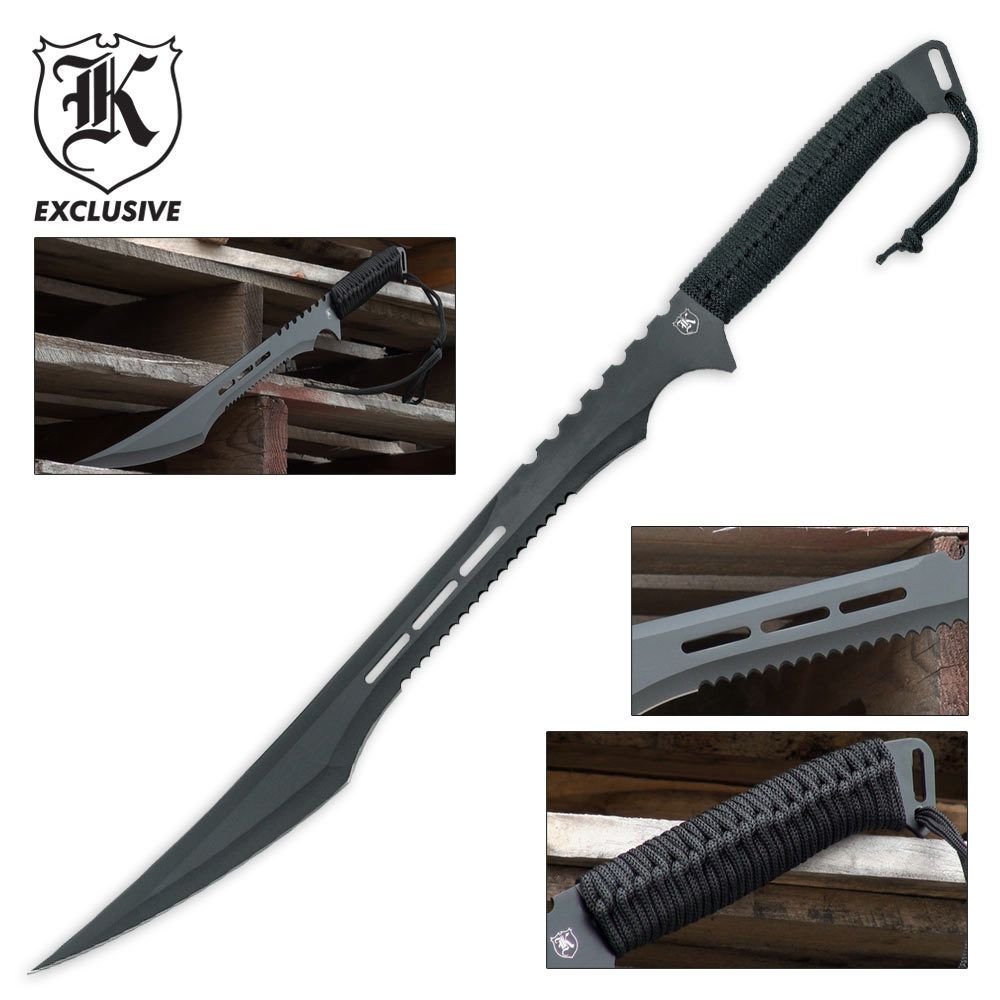
Technically, survival knives can be defined as knives that are in good condition. Certainly, possessing a knife gives you a far greater probability of braving the elements, compared to not having one. Nonetheless, when most people speak of "survival knives", they are referring to particular types of knives that are associated with that phrase. These knives feature hollow handles intended to store numerous emergency supplies, and the kind of hunting blades that are found on Bowie knives.
Typically,
survival knife handles are coarse, to offer a superior grip. Frequently, the handle tips contain floating compasses, which make up some of the emergency supplies. The remainder of the emergency kits are stored within the handles themselves. Survivalists can open up the handles to access a range of helpful items. For example, many survival knives hold fishing lines, matches, wire saws, fish hooks, water purification pills, needles and cotton, bits of flint and medical supplies. Notwithstanding, the majority of soldiers and survivalists customize the supplies they carry to fit their particular requirements.
Many knife aficionados regard survival knives with hollow handles as gimmicks, instead of helpful tools. However, some people report that they feel safer, when they take these knives with them on camping trips. Normally, these knives have smooth blades for food preparation, or stabbing animals. They have jagged edges for cutting tree branches as well. Furthermore, a survival knife can have a curved blade, to cut rope or open aluminium cans. Often, to prevent glare, black matte finish is applied to the blades of these knives. Some survival gurus say that stainless steel knives should be avoided, because flint can not be used with them to start fires.
A
survival knife could be the difference between life and death. Nonetheless, it could be harmful, if you use it incorrectly. One fundamental safety procedure is to keep the blade away from the body when slicing. Stay alert to everything that is happening, and make sure that you grasp the handle firmly. Also, check that the object you are slicing is secure, to avoid any accidents. Moreover, be careful not to attempt to catch the knife if it falls, or run while holding it. If you are shutting a folding knife, use both hands. Finally, before putting the knife down, always put it back in its' sheath.
Rather than purchasing a traditional survival knife, some survivalists advise purchasing a small survival kit and a good quality hunting knife. Other experts say that traditional survival knives, with well stocked handles, are more portable than separate hunting knives and emergency supplies. Notwithstanding, a hollow knife handle reduces the tang of the blade, which sacrifices strength. Also, if you misplace the knife, you could be without some crucial pieces of kit. This is why it is best to store other important supplies separately. All experts concur that the handle and blade on a knife are the most important features. Furthermore, it is crucial to protect the blade from the elements and keep it as sharp as possible.